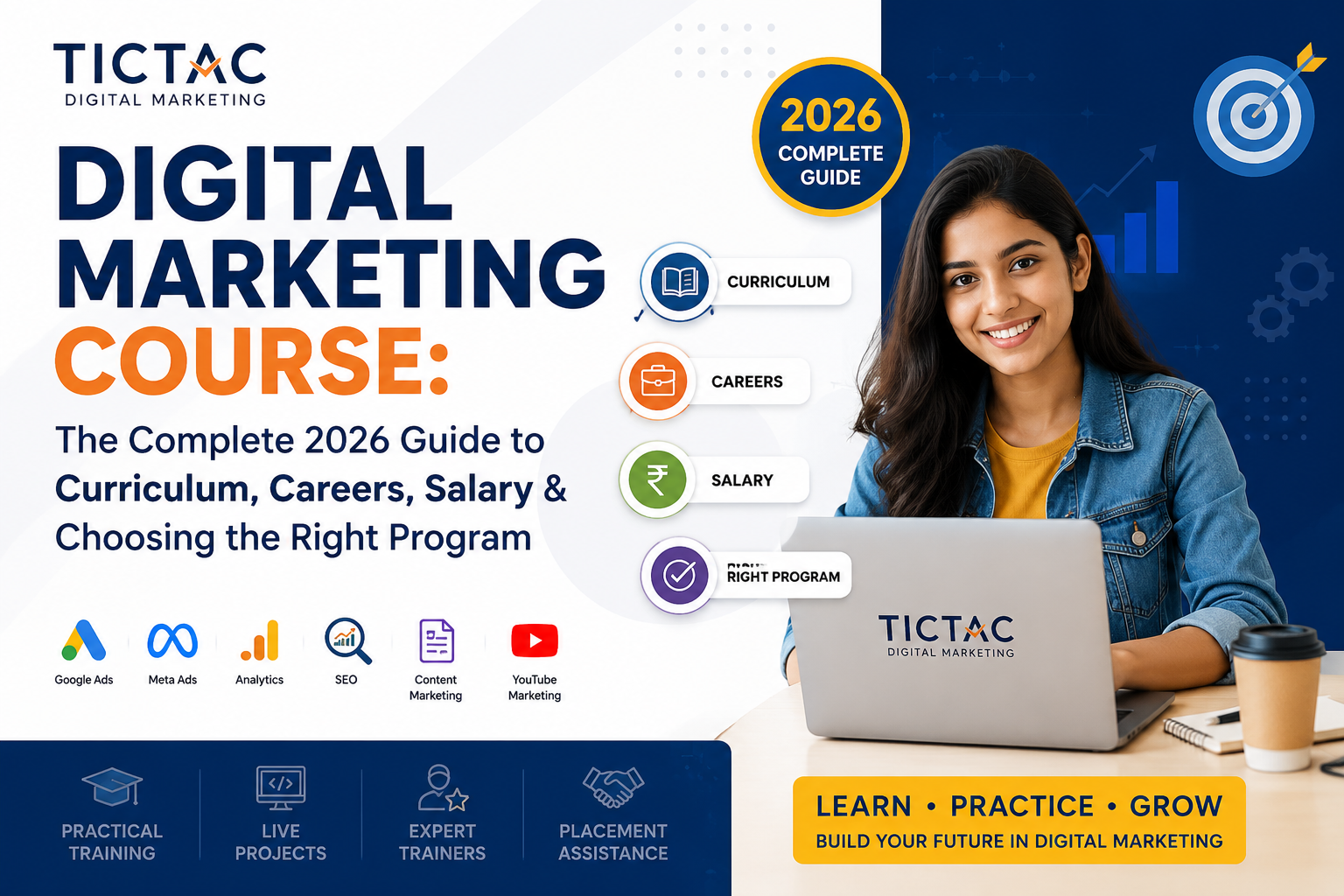
Digital Marketing Course: The Complete 2026 Guide to Curriculum, Careers, Salary & Choosing the Right Program
- Admintictac
- 04/07/2026
- Digital Marketing Course
- 0 Comments
Digital marketing is no longer a “nice to have” skill it’s the backbone of every business, from small to global brands. If you are thinking a digital marketing course in 2026, you’re getting into one of the fastest-moving, demand career paths in the job market. This guide covers everything you need to know: what a digital marketing course actually teaches, which skills matter most, salary expectations and exactly how to choose a program that leads to a real job.
What Is a Digital Marketing Course?
A digital marketing course is a training program online, in-person or hybrid that teaches the skills, tools and strategy needed to plan, execute and measure marketing campaigns across digital channels. This includes search engine optimization (SEO), paid advertising (Google Ads, Meta Ads), social media marketing, content strategy, email marketing, analytics, and increasingly.
Courses range from short 4–6 week certification programs with placement support. The right choice depends on your starting point, your goals and how quickly you need job-ready skills.
Why Digital Marketing Is One of the Smartest Skill to Learn in 2026
The digital marketing industry continues to grow at a rapid pace. Global digital advertising spend is projected to top $800 billion in 2026, and businesses of every size not just tech companies are shifting marketing budgets online because that’s where customers now spend their attention. Search behavior itself is changing fast too: conversational, voice, and AI-assisted search are becoming the norm and companies are actively hiring people who understand how to market to both humans and algorithms.
On the hiring side, demand is strong and getting stronger. Marketing and creative leaders report aggressive hiring plans, with a majority expanding permanent headcount and many increasing contract hiring while at the same time, a large share say finding genuinely skilled talent has gotten harder, not easier. That skills gap is exactly what a good digital marketing course is designed to close. Employers increasingly treat AI-assisted SEO, marketing automation and data-driven campaign skills as core requirements, not bonus qualifications and marketing professionals with strong AI expertise are already commanding meaningfully higher pay than peers without it.
What You’ll Actually Learn: A Realistic Curriculum Breakdown
A strong, employer-relevant digital marketing course in 2026 should cover far more than “how to post on Instagram.” Look for a curriculum built around these core modules:
- Search Engine Optimization (SEO) & AI Search
- Paid Advertising & Performance Marketing
- Content & Social Media Strategy
- Analytics & Data-Driven Decision Making
- Marketing Automation & AI Tools
- Strategy, Ethics & Human-Centered Marketing
Based on current hiring trends, prioritize a course that builds these specific, verifiable skills:
AI-assisted SEO and content workflows not as an elective, but as a core competency
Marketing automation platform proficiency (not just theory hands-on tool experience)
Data analysis and campaign reporting, since roles centered purely on repetitive metric-pulling are increasingly automated, while strategic interpretation of that data is not
Multi-platform, omnichannel campaign management
A 2023 McKinsey estimate found that up to 45% of marketing activities could be automated with current technology which makes it critical to choose a course that goes beyond execution-level tasks (writing captions, scheduling posts) and builds strategic, judgment-based skills that remain valuable even as automation expands.
Career Paths & Salary Expectations
A digital marketing course can lead to a wide range of roles, depending on specialization:
Beyond entry-level roles, specializing further in performance marketing, SEO strategy, marketing analytics or AI-driven campaign management tends to command a premium, with professionals who demonstrate strong AI marketing expertise earning noticeably more than generalist peers. Career growth typically moves from specialist → manager → strategist/director roles, often within 3–5 years for those who actively build a portfolio.
Not all courses are created equal. Use this framework before enrolling:
Curriculum currency
Does it explicitly teach AI-assisted SEO, AEO and current-generation marketing automation tools or is it built around outdated, AI marketing tactics?
Hands-on, project-based learning
Look for live campaigns, real client or simulated projects and a portfolio you finish with not just video lectures and quizzes.
Instructor credibility
Are instructors named, with verifiable industry experience and current (not decade-old) campaign results?
Placement and career support
Does the program offer resume support, interview prep, or employer partnerships? This is the difference between a certificate and an actual job.
Online vs. In-Person: Which Should You Choose?
Online courses offer flexibility, often lower cost and access to instructors, regardless of location ideal for working professionals upskilling alongside a job.
In-person or hybrid programs tend to offer stronger networking, more direct mentorship and sometimes more robust placement pipelines through local employer partnerships often a better fit for career-changers.
Real-World Example: What a Strong Learning Path Looks Like
Consider a mid-career professional shifting from a non-marketing role into digital marketing. A well-structured path typically looks like:
FAQs: Digital Marketing Course
Is a digital marketing course in Vijayawada worth it in 2026?
Yes, for most careers into marketing the industry is growing, digital ad spend continues to rise and employers are actively struggling to find candidates with current, AI-integrated marketing skills. It depends on choosing a course with hands-on projects.
How long does it take to complete a digital marketing course?
Most structured programs run weeks for a solid foundation, though certification programs with specialization tracks can run months. Learners often take longer depending on their weekly time commitment.
Do I need a marketing degree to take a digital marketing course?
No. Digital marketing courses are designed to be accessible to any background many successful digital marketers come from unrelated fields like teaching, customer service, or finance and build their skills entirely through course.
What’s the difference between a digital marketing course and a digital marketing certification?
course is the learning process; a certification is a credential verifying you completed it. Certifications from recognized platforms or well-regarded institutes carry more weight than unverified certificates.
How much does a digital marketing course cost?
Costs vary widely from introductory content to several hundred or a few thousand for comprehensive, mentor-led programs with placement support.
A digital marketing course in 2026 is one of the highest-leverage career investments you can make but only if you choose a program built around current, Integrated skills, hands-on project work and real career support. Focus on curriculum, instructor credibility and transparent outcomes, then you’ll come out with far more than a certificate with a portfolio and employers are actively hiring.